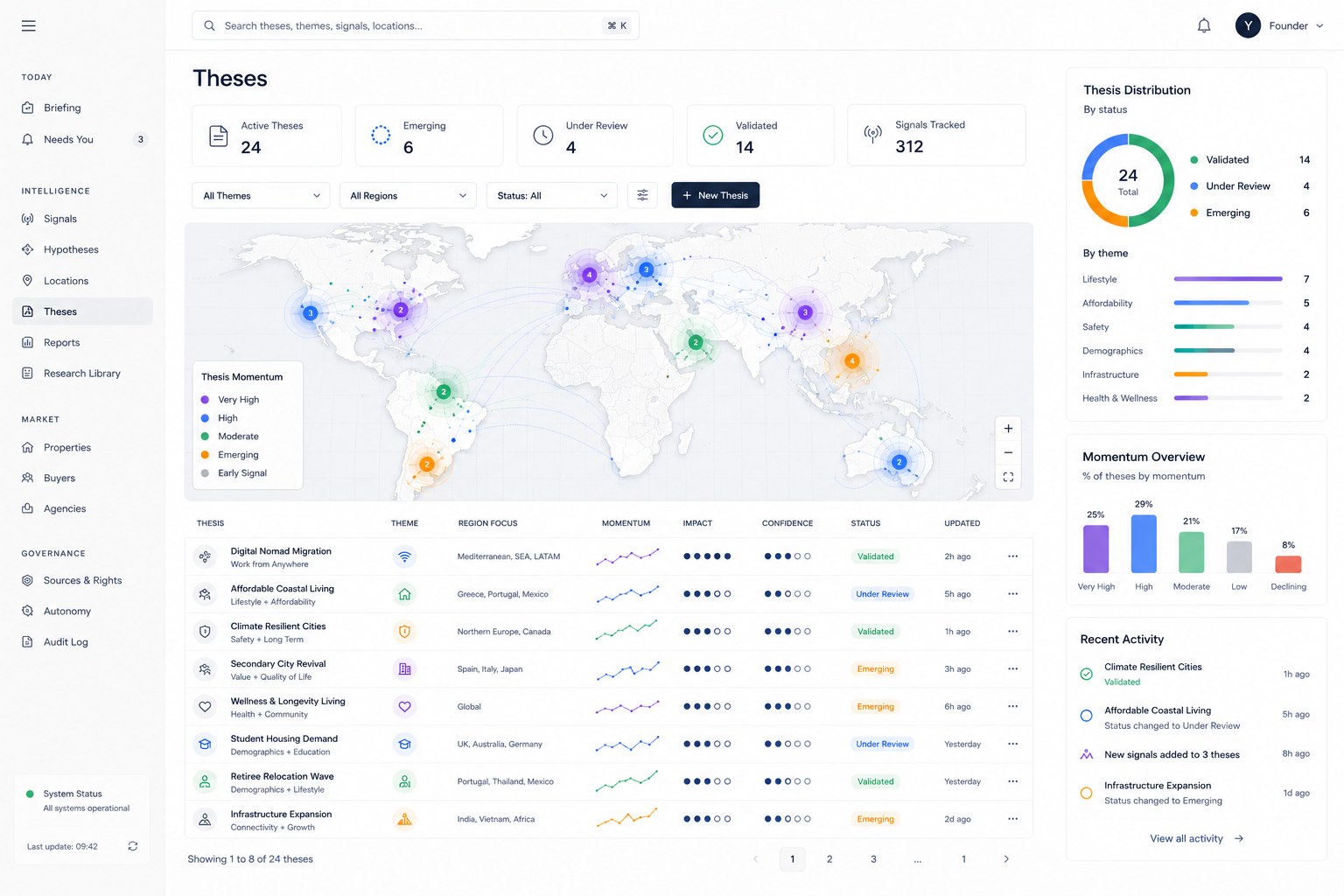
We study the forces behind changing ways of living.
Real-estate demand is the visible outcome of deeper changes in how people work, move, form households, seek belonging, manage cost and define quality of life.
Our research draws on sociology, psychology, anthropology, demography, behavioral economics and urban studies. These disciplines help us understand not only what people say they want, but how preferences, constraints and trade-offs translate into decisions about place.
We examine the relationship between people and the environments they choose — including work, family, mobility, community, identity, nature, affordability, independence and belonging.
We are not looking for passing preferences. We are looking for changes capable of altering geography.


We observe change as it becomes measurable.
Changes in human behavior leave traces across the world.
We monitor signals that may reveal evolving needs, constraints and patterns of movement. These can include search behavior, online communities, migration, tourism, housing affordability, economic conditions, remote work, infrastructure, geopolitical developments, climate resilience, international mobility and real-estate activity.
Each source reveals only part of the picture. Search behavior may indicate growing interest, but not commitment. Migration data may confirm movement after it has already begun. Market data may show a price response without explaining the human change behind it.
That is why we do not rely on any single signal. We look for persistence, acceleration, geographic concentration and corroboration across independent sources.
The goal is not to predict the future with certainty. It is to identify meaningful change early — and understand what is driving it.