Our Approach – Future Living Intelligence
Erestel Intelligence

Our Approach

From human change to real-estate opportunity.

Traditional real-estate analysis often begins with the property.

We begin earlier — with the human forces that shape where demand forms.

We combine qualitative human research, quantitative data and AI-assisted analysis to understand not only what a place is today, but what it may be becoming.

02
Human Futures Intelligence

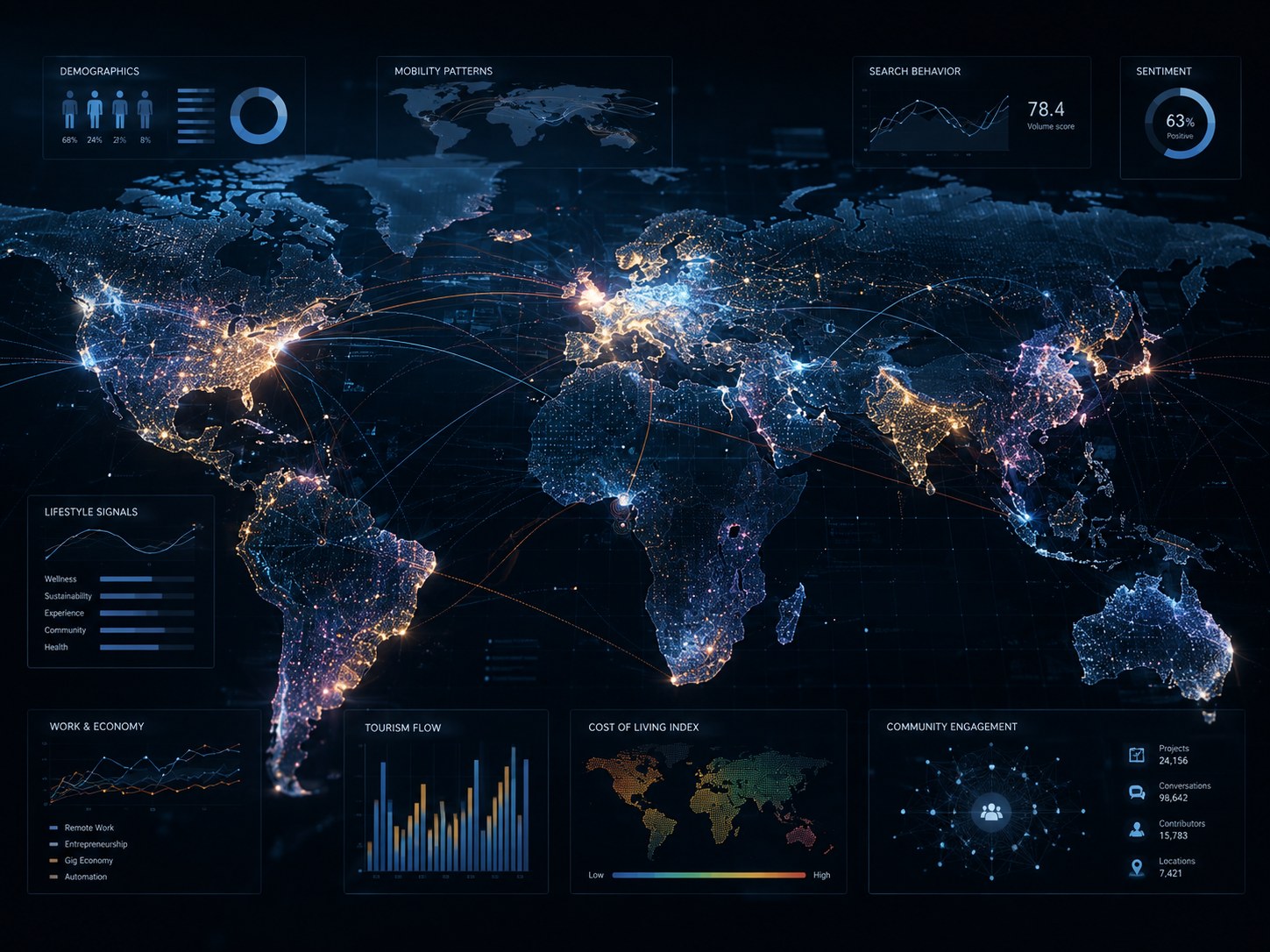
We study the forces behind changing ways of living.

Real-estate demand is the visible outcome of deeper changes in how people work, move, form households, seek belonging, manage cost and define quality of life.

Our research draws on sociology, psychology, anthropology, demography, behavioral economics and urban studies. These disciplines help us understand not only what people say they want, but how preferences, constraints and trade-offs translate into decisions about place.

We examine the relationship between people and the environments they choose — including work, family, mobility, community, identity, nature, affordability, independence and belonging.

We are not looking for passing preferences. We are looking for changes capable of altering geography.
Human Futures Intelligence
World Signals
03
World Signals

We observe change as it becomes measurable.

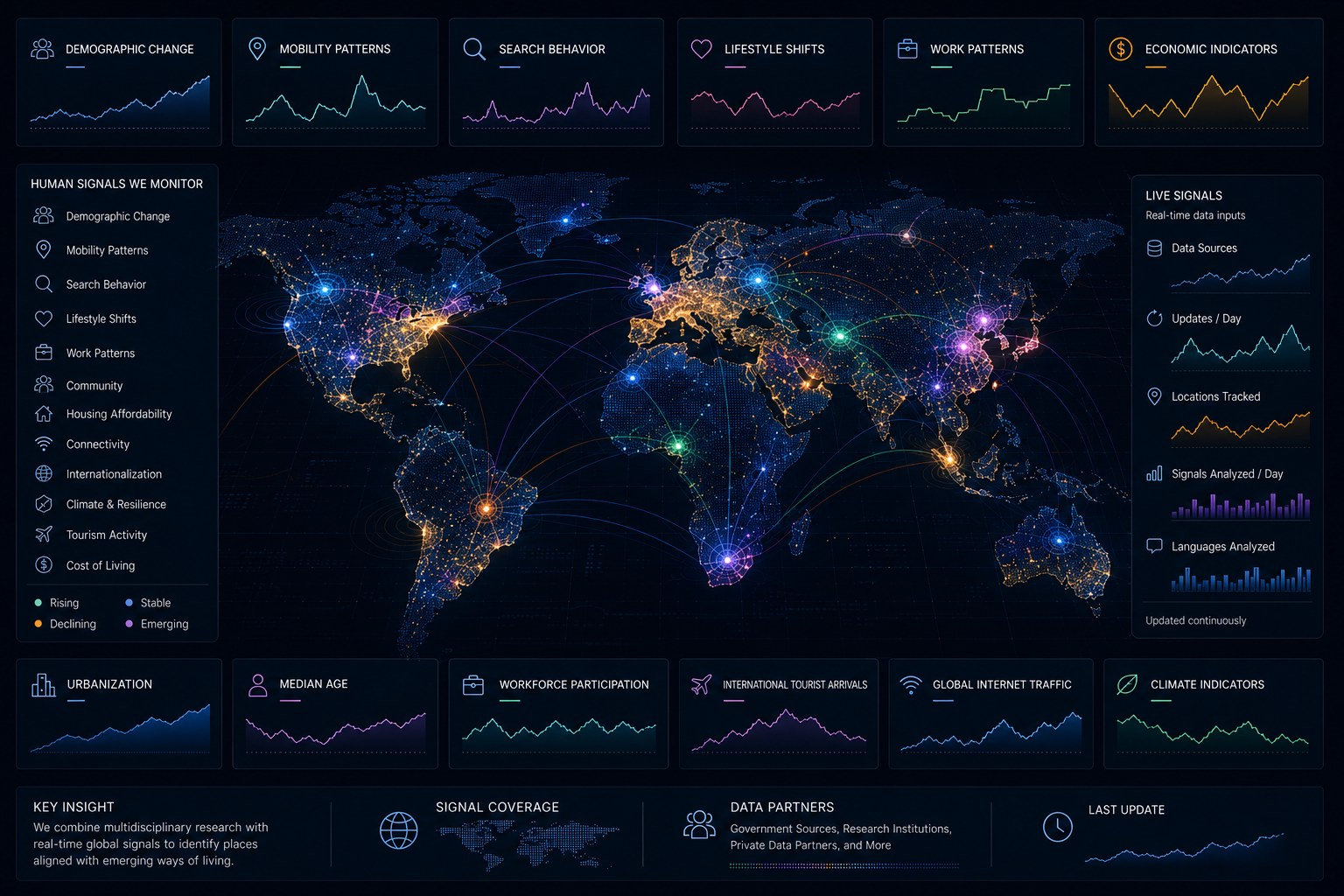
Changes in human behavior leave traces across the world.

We monitor signals that may reveal evolving needs, constraints and patterns of movement. These can include search behavior, online communities, migration, tourism, housing affordability, economic conditions, remote work, infrastructure, geopolitical developments, climate resilience, international mobility and real-estate activity.

Each source reveals only part of the picture. Search behavior may indicate growing interest, but not commitment. Migration data may confirm movement after it has already begun. Market data may show a price response without explaining the human change behind it.

That is why we do not rely on any single signal. We look for persistence, acceleration, geographic concentration and corroboration across independent sources.

The goal is not to predict the future with certainty. It is to identify meaningful change early — and understand what is driving it.
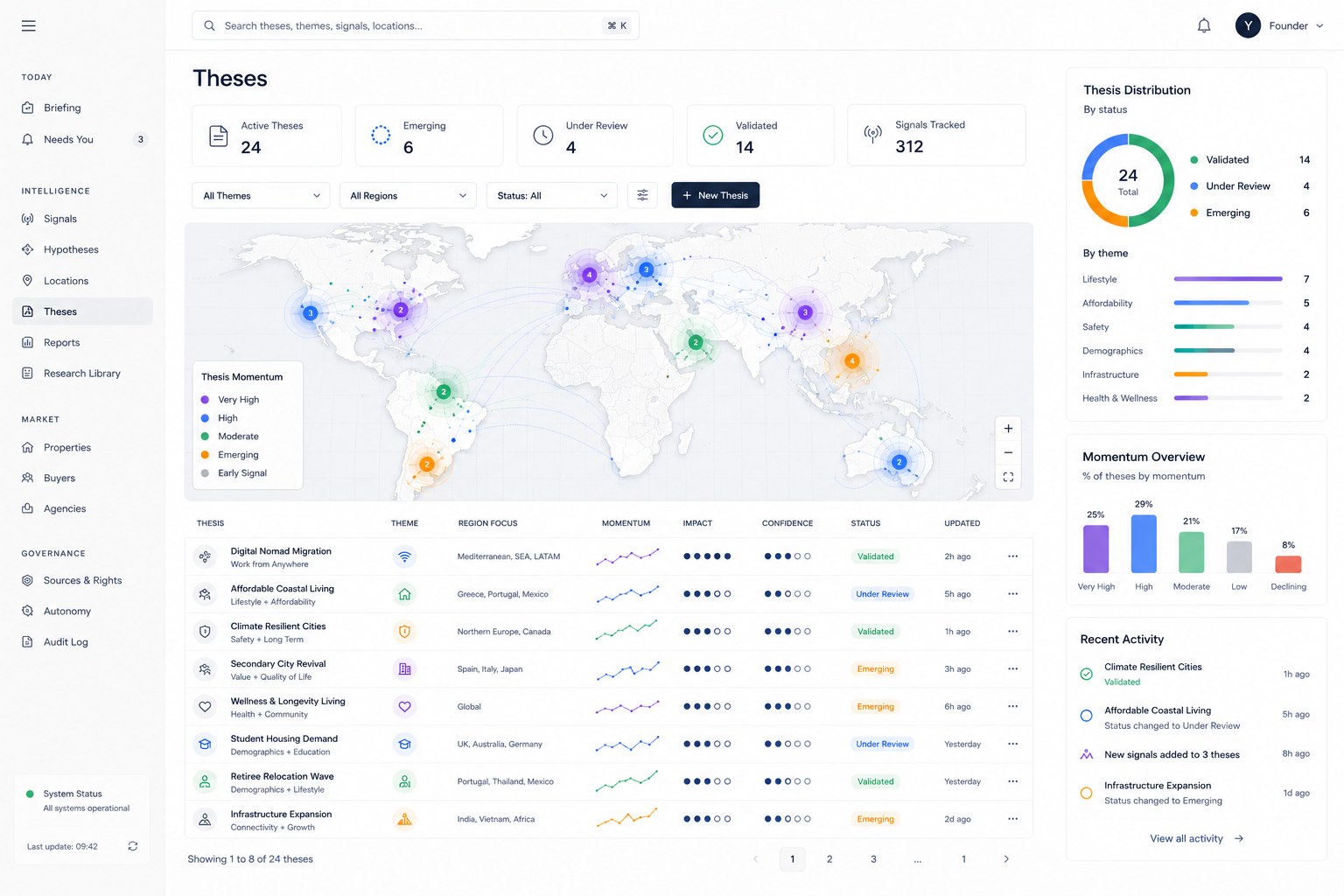
Intelligence Synthesis

We connect fragmented evidence into coherent theses.

Meaningful change rarely appears in one complete dataset.

It emerges through weak, partial and sometimes contradictory evidence across human behavior, economics, culture, mobility, technology, geography and property markets.

Our technology organizes and compares these signals across time and place. AI-assisted analysis helps surface relationships, anomalies and patterns that may not be visible when each source is viewed separately.

Human judgment provides context, challenges assumptions and determines whether an apparent relationship is genuinely meaningful.

Every emerging thesis must answer a clear set of questions:

  • What is changing?
  • Why is it changing now?
  • Where is the change becoming concentrated?
  • Who or what is driving it?
  • Which evidence supports the thesis?
  • What evidence would weaken or invalidate it?

AI is not the thesis. It is the connective layer that helps us build, test and continuously update one.

05
Location Intelligence

We identify places where human intent and structural conditions align.

A place can be desirable without being accessible.

It can be affordable without being connected. Fast-growing without being resilient. Visually attractive without offering the conditions required to support lasting demand.

We are interested in places where multiple forces begin to reinforce one another — where changing human preferences are supported by the practical, economic and geographic realities of the location.

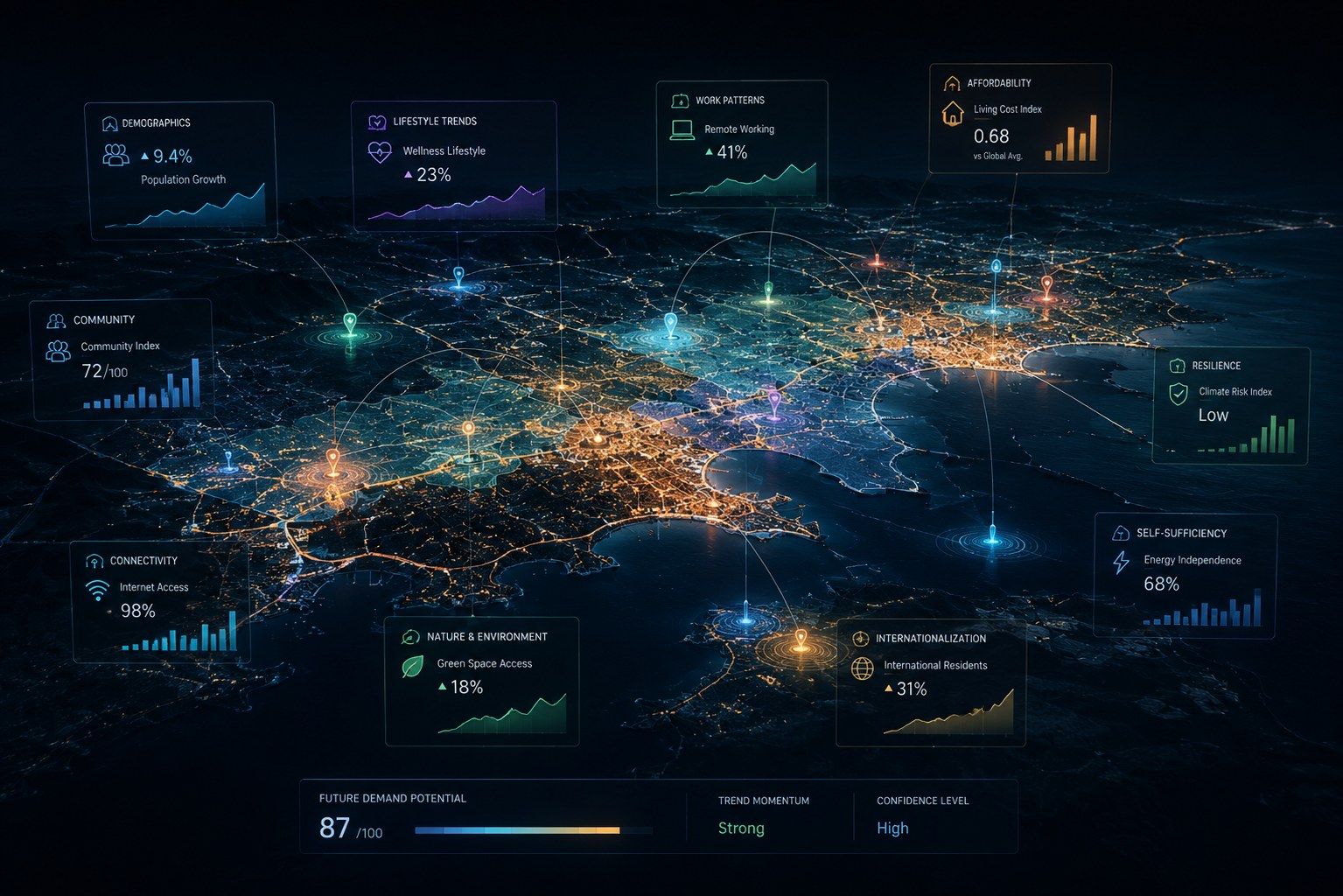
We evaluate factors such as:

Location Intelligence
01

Community

The strength of local relationships, social infrastructure, identity and belonging.

02

Affordability

The accessibility of housing and everyday life relative to alternative locations.

03

Nature and Lifestyle

The quality of the physical environment and the way of life a place can support.

04

Connectivity

Physical and digital access to employment, services, cities, markets and international networks.

05

Internationalization

The ability of a place to attract, receive and support people, capital and activity from outside its immediate region.

06

Resilience

The capacity of a location to remain functional, livable and relevant through environmental, economic and social change.

07

Self-Sufficiency

The extent to which daily needs, essential services and economic activity can be supported locally.

08

Housing Value

The relationship between current pricing and the quality, utility and future relevance of the location.

These factors are not evaluated in isolation.

Affordability means something different when connectivity is improving. Lifestyle appeal becomes more significant when infrastructure can support new demand. Resilience matters more when it directly affects long-term livability and continuity.

The value lies in understanding how these conditions interact.

Not simply: Where is property cheap?

But: Where may future demand emerge — and why?

Location Theses

We build explanations, not just rankings.

A score can help compare places. A thesis must explain them.

For every location under consideration, we develop a structured view of the change that may be taking place, the people it may attract, the conditions supporting it, the timeframe in which it may become relevant and the risks that could weaken the case.

We distinguish between:

  • Observed evidence and interpretation.
  • Leading indicators and lagging confirmation.
  • Temporary attention and structural change.
  • Current appeal and future relevance.
  • Potential and investability.

A location thesis is never treated as static. As new evidence enters the system, the thesis may strengthen, become more specific, change in timing or be discarded entirely.

We actively examine alternative explanations, data limitations, downside conditions and the possibility that the market has already recognized the change.

A place becomes interesting not when one signal is strong, but when independent signals begin to tell the same story.

Real Estate Discovery
07
Real Estate Discovery

Our technology searches for assets that fit the thesis.

Only after a location thesis reaches sufficient confidence does the search move from geography to property.

The system searches for real-estate opportunities that align with the underlying logic of the location. Individual properties are evaluated according to their location, price, characteristics, use potential, market context, liquidity, downside and alignment with the future-living thesis.

An inexpensive property is not necessarily an opportunity. A desirable property is not necessarily well priced. A strong location does not automatically make every asset within it attractive.

The property becomes relevant when its individual fundamentals and the wider location thesis support the same conclusion.

The property is not the starting point. It is the physical expression of the thesis.

From Thesis to Opportunity

We connect human insight with real assets.

When the evidence aligns, the result is not simply a property search or a market ranking.

It is a reasoned view of why a particular asset, in a particular place, may be positioned for a particular form of future demand.

The opportunity is understood within a wider context:

  • Who may want to live there.
  • Why the location may become more relevant.
  • Which conditions support that change.
  • How the property fits the location thesis.
  • What must still happen for the thesis to mature.
  • And what could prevent it from doing so.

This allows the analysis to move from a broad observation about the world to a specific opportunity in the physical world.

From human behavior, to geographic relevance, to real-estate opportunity.

How It Works

From human change to real-estate opportunity.

The process is sequential, but the intelligence is continuous.

Each stage informs and challenges the others as new evidence enters the system.

01

Human Research

Understanding changing needs, behaviors and ways of living.

Sociology · Psychology · Anthropology · Demography · Behavioral Economics

02

World Signals

Monitoring social, economic, technological and geographic change.

Economics · Migration · Culture · Technology · Mobility · Lifestyle

03

Intelligence Synthesis

Connecting fragmented evidence into structured, testable theses.

AI-Assisted Analysis · Cross-Source Corroboration · Continuous Updating

04

Emerging Locations

Identifying places where human intent and structural conditions align.

Location Fit · Timing · Resilience · Demand Potential · Future Relevance

05

Property Discovery

Finding assets that fit validated location theses.

Price · Characteristics · Use Potential · Market Context · Downside

06

Real Estate Opportunities

Translating intelligence into specific opportunities in the physical world.

From Human Change to Real Assets

Our Method

From signals to place. From place to property.

Our approach is designed to make change legible — to understand what is shifting, where it is concentrating, why it matters and how it may eventually take physical form.

Explore the Intelligence